

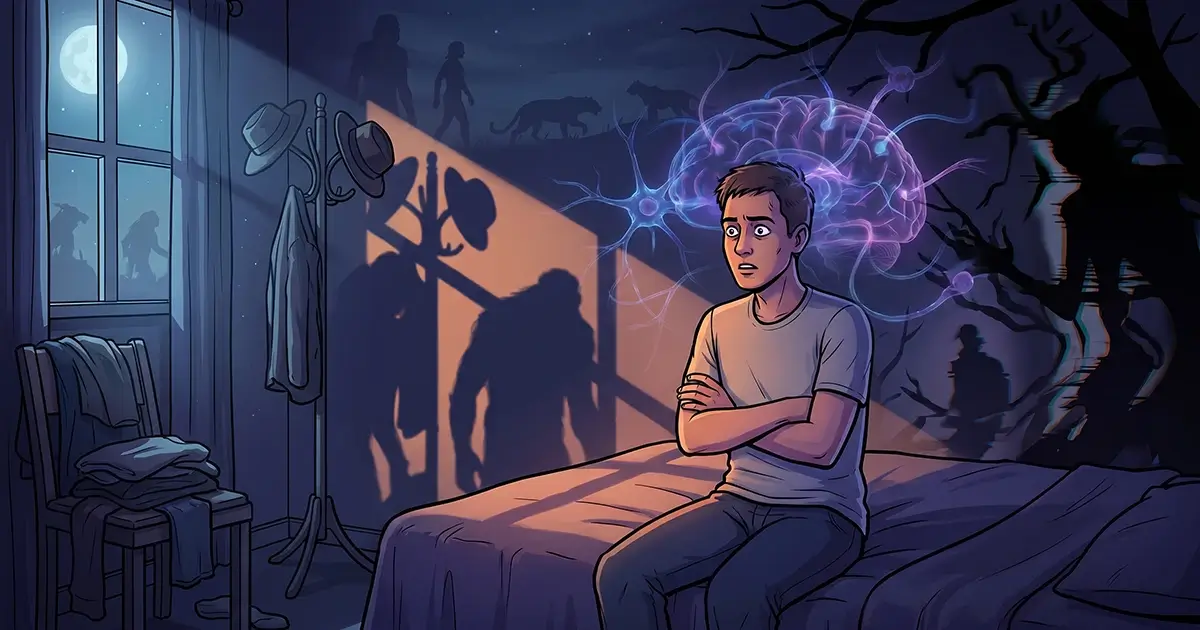
Fear of the dark is one of the most universal human experiences. It shows up in childhood, sometimes lingers into adulthood, and often feels irrational on the surface. We know logically that darkness itself is harmless, yet our body still reacts with tension, alertness, and sometimes even panic.
This isn’t a random glitch in the mind. It is a deeply rooted survival mechanism shaped by thousands of years of evolution. When humans lived in environments full of predators, darkness meant reduced visibility and increased danger. The brain learned to compensate for this uncertainty by becoming more alert and imaginative in low-light conditions.
Modern neuroscience suggests that fear of the dark is less about darkness itself and more about what the brain cannot confirm. When visual input drops, the brain starts predicting possible threats based on limited information. These predictions are often biased toward danger because, from a survival perspective, false alarms were safer than missed threats.
Below are four real psychological patterns that explain why darkness affects human perception so strongly.
Example 1: Peripheral Vision Distortion in Low Light

One of the most common nighttime experiences is seeing shapes in the corner of your eye that disappear when you look directly at them. This happens because peripheral vision is less precise than central vision, especially in low light conditions.
The brain constantly tries to construct a complete image of the environment using incomplete data. At night, when lighting is weak, the visual system receives fewer details. To fill in the gaps, the brain relies on pattern recognition, often matching random shapes to familiar threats like human figures or animals.
This is why a pile of clothes on a chair can briefly look like a person standing in the room. The brain prioritizes speed over accuracy in low visibility situations. It would rather misidentify an object than miss a real threat.
This effect becomes stronger when a person is already anxious or tired. Fatigue reduces cognitive filtering, making it easier for the brain to misinterpret ambiguous shapes. This is not imagination in a creative sense, but a predictive survival response built into human perception.
Example 2: Auditory Threat Bias at Night

At night, many people experience heightened sensitivity to small sounds. A floor creak, wind outside, or distant noise can feel amplified and meaningful. This is known as auditory threat bias.
When vision is reduced, the brain increases reliance on hearing. However, hearing is also interpretive rather than exact. The brain does not simply record sound; it interprets it based on expectation and context.
In silence and darkness, the lack of visual confirmation increases uncertainty. This makes the brain more likely to interpret random sounds as potential threats. A harmless noise becomes a “possible intruder” scenario in the mind before any real evaluation occurs.
This mechanism is linked to the brain’s threat detection system, particularly the amygdala, which scans for danger signals and triggers alertness when uncertainty is high. Historically, reacting quickly to a false sound could mean survival, while ignoring a real threat could be fatal.
As a result, nighttime environments naturally amplify sound-based imagination. The mind tries to assign meaning to every noise because “unknown” is treated as “potential danger.”
Example 3: Half-Sleep Hypervigilance and Threat Simulation

Another strong factor in nighttime fear is the transition state between wakefulness and sleep. In this phase, the brain is not fully asleep but also not fully alert. This creates a condition where imagination and perception can blend.
In this state, people often feel sudden alertness, the sensation of presence in the room, or a vague sense of danger without any actual stimulus. This happens because the brain’s monitoring systems remain partially active while rational processing slows down.
The mind can generate threat simulations during this phase. These simulations are not dreams in the traditional sense but fragmented interpretations of environmental uncertainty. Shadows, faint noises, or even internal bodily sensations can be misread as external threats.
This is also why people sometimes feel like they are being watched just before falling asleep or right after waking up. The brain is still operating in a protective mode, scanning for danger patterns even when none exist.
This mechanism is not a malfunction. It is a protective overlap system where the brain refuses to fully “switch off” threat detection until it is confident of safety.
Example 4: Why the Dark Feels Like Something Is Hiding in It

Most people think they are afraid of the dark itself, but in reality they are reacting to uncertainty. Darkness removes one of the brain’s most trusted input sources: vision. Without it, the mind starts filling in the missing information using predictions instead of facts.
When the lights go out, the brain shifts into a high-alert state. It begins scanning memories, sounds, and patterns to simulate what might be present. This is where worst-case thinking becomes dominant.
Thousands of years ago, humans who ignored strange sounds or movement in the dark were more likely to be harmed by predators. Those who stayed alert had a better chance of survival. Over time, this created a strong evolutionary bias toward caution in low visibility environments.
That “someone is watching you” feeling is not paranormal. It is your brain running an ancient survival program designed to detect hidden threats. It is essentially a prediction system operating without enough data, so it assumes the most cautious outcome.
This is why even in completely safe modern environments, like a bedroom at night, the mind can still react as if danger is possible. The emotional system evolved much faster than modern living conditions, so it still treats darkness as a signal to stay alert.
Frequently Asked Questions
Why am I scared of the dark even as an adult?
Fear of darkness can persist into adulthood because it is linked to automatic brain systems, not conscious thinking. The brain’s threat detection network responds to uncertainty in low light, even when you logically know you are safe.
Is fear of the dark psychological or biological?
It is both. Biologically, it is tied to survival mechanisms in the brain. Psychologically, it is reinforced by attention, imagination, and past experiences.
Why does my imagination get worse at night?
At night, sensory input decreases, so the brain compensates by increasing internal prediction. This makes imagination more active and sometimes more fear-based.
Can fear of the dark be reduced?
Yes. Gradual exposure, improving sleep routines, and reducing nighttime anxiety triggers can help retrain the brain’s response over time.
Is it normal to feel like someone is in the room at night?
Yes, this can happen due to heightened threat detection during low light or half-sleep states. It is a known perceptual effect and not unusual.
Fear of the dark is not about ghosts or irrational thinking. It is about a brain that is doing exactly what it evolved to do: keep you safe in situations where information is incomplete.

Comments (0)
No comments yet. Be the first to share your thoughts!
Leave a comment
Your comment will appear after it's reviewed. Your email is never shown publicly.