

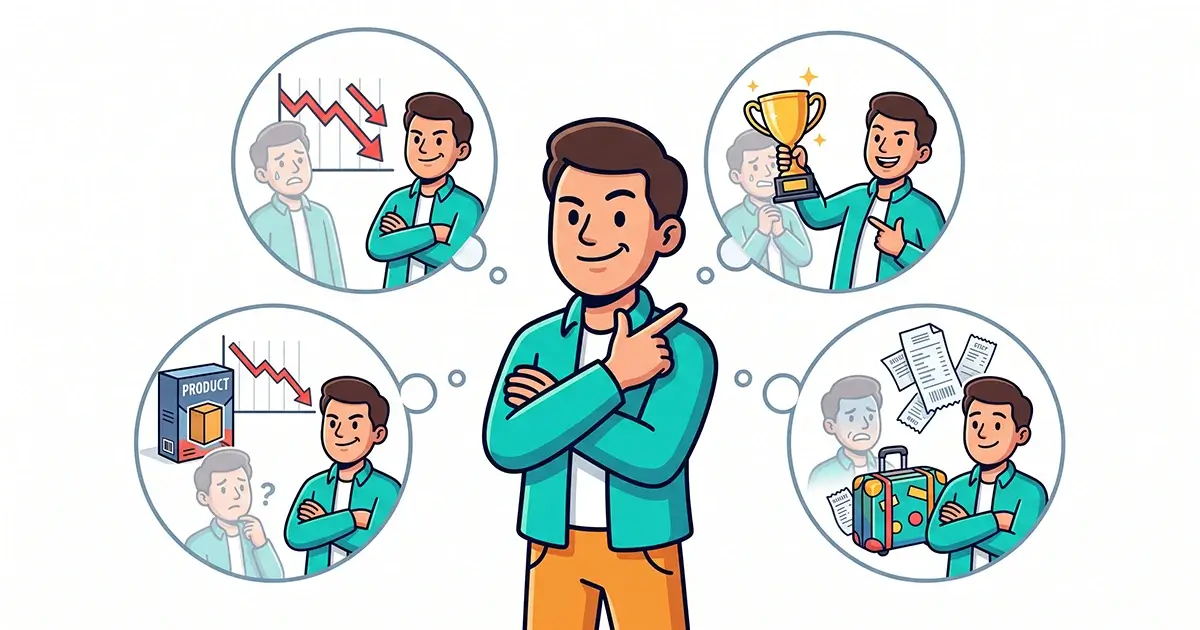
Have you ever looked back at a situation and thought, "I knew that was going to happen"?
Maybe a sports team lost exactly as expected. Maybe a stock crashed after months of hype. Or perhaps a relationship ended and suddenly every warning sign seemed obvious.
This feeling is incredibly common, but psychology suggests that many of these moments are not accurate memories. Instead, they are often the result of a cognitive distortion known as hindsight bias.
Hindsight bias is the tendency to see past events as more predictable than they actually were. Once we know the outcome, our brains rewrite history and convince us that we saw it coming all along.
This mental shortcut can make us feel wiser and more informed, but it can also distort learning, decision-making, and self-awareness.
What is Hindsight Bias?
Hindsight bias occurs when people believe they predicted an outcome after it has already happened, even when they had little or no confidence beforehand.
Psychologists sometimes refer to this as the "I-knew-it-all-along" effect.
The bias happens because our brains naturally seek coherence and certainty. Once an event occurs, all the information leading up to it appears clearer and more connected than it actually was in real time.
As a result, we underestimate uncertainty and overestimate our ability to predict events.
Why Does Hindsight Bias Happen?
The human brain constantly tries to create meaningful stories from information.
When an outcome becomes known, the brain automatically reorganizes memories to fit the result. Details that support the outcome become easier to recall, while conflicting information fades into the background.
Several psychological factors contribute to hindsight bias:
Memory Reconstruction
Human memory is not a perfect recording device. Every time we remember something, we partially reconstruct it.
This reconstruction process allows current knowledge to influence how we remember past beliefs and expectations.
Desire for Predictability
People prefer to feel that the world is understandable and controllable.
Believing that events were predictable reduces feelings of uncertainty and anxiety.
Self-Confidence Protection
Admitting that an outcome surprised us can feel uncomfortable.
Hindsight bias protects our self-image by making us believe we were more knowledgeable than we actually were.
Example 1: The Stock Market Crash

Imagine an investor who owns shares in a rapidly growing company.
Financial news outlets are optimistic, analysts are divided, and investors are uncertain about the future.
A few months later, the company reports poor earnings and the stock price collapses.
After the crash, the investor says, "I knew this company was overvalued from the beginning."
However, if someone reviewed the investor's earlier comments, they might discover that the investor was actually expecting the stock to continue rising.
The known outcome has altered the investor's memory.
This is a classic example of hindsight bias. Once the result becomes obvious, people often forget how uncertain the situation really was.
How Hindsight Bias Affects Learning
One of the biggest dangers of hindsight bias is that it interferes with learning.
If people believe they predicted outcomes correctly, they may fail to analyze what actually happened.
Instead of asking:
"What information did I miss?"
They ask:
"Why did everyone else miss something that was obvious?"
This mindset can prevent growth and encourage overconfidence.
True learning requires acknowledging uncertainty and accepting that outcomes are often difficult to predict.
Example 2: The Championship Game

A sports fan watches a championship match between two evenly matched teams.
Before the game, experts disagree about who will win.
Some predict Team A while others predict Team B.
After Team A wins, the fan confidently claims, "The result was obvious. Team A was clearly the better team."
But before kickoff, the same fan may have been uncertain or even leaning toward Team B.
The final score changes how the fan interprets everything that happened before the game.
The outcome feels inevitable even though it wasn't.
This demonstrates how hindsight bias can distort our perception of probability.
Hindsight Bias in Relationships
Relationships provide fertile ground for hindsight bias.
When relationships end, people often revisit the past and reinterpret earlier events as warning signs.
While some warning signs may have existed, many only seem obvious because the ending is already known.
This can create an illusion that the outcome was unavoidable.
In reality, relationships are complex and uncertain, and many situations could have developed differently.
Example 3: The Failed Business Launch

A small company launches a new product after months of research and development.
The team feels confident because market surveys and customer feedback are positive.
Unfortunately, the product performs poorly after launch.
Observers quickly begin saying things like:
"The product was doomed from the start."
"The warning signs were obvious."
"They should have known better."
Yet these same observers likely did not make those predictions beforehand.
The failure makes certain details appear more important than they seemed at the time.
Hindsight bias encourages people to judge past decisions based on outcomes rather than the information available when those decisions were made.
Why Outcomes Shouldn't Define Decisions
Good decisions do not always produce good outcomes.
Likewise, bad decisions do not always produce bad outcomes.
A decision should be evaluated based on the quality of information available when it was made.
For example, a poker player can make the statistically correct move and still lose the hand.
Judging decisions only by results ignores the role of uncertainty and chance.
Hindsight bias often causes people to confuse outcome quality with decision quality.
Example 4: The Expensive Vacation

A family plans a vacation months in advance.
They compare hotels, estimate expenses, and create a budget based on available information.
During the trip, unexpected costs begin piling up.
Transportation becomes more expensive than expected, activities cost extra, and dining expenses exceed the original estimates.
When the vacation ends, someone becomes frustrated and says:
"I knew this trip was going to be expensive."
The statement feels true because the outcome is already known.
However, before the trip, that same person may have agreed with the budget and expected costs to remain manageable.
The brain is now rewriting history to make the result seem predictable.
This is hindsight bias in everyday life.
The same pattern appears when a recipe turns out bland and someone insists they always knew it needed more seasoning.
Once the outcome is known, people often overestimate how accurately they predicted it.
How to Reduce Hindsight Bias
Completely eliminating hindsight bias is difficult, but there are ways to reduce its influence.
Keep Records of Predictions
Writing down expectations before events occur can provide an accurate reference later.
This prevents memory from being unconsciously rewritten.
Consider Alternative Outcomes
Ask yourself what other outcomes could reasonably have happened.
This helps maintain awareness of uncertainty.
Focus on Available Information
Judge decisions based on what was known at the time rather than what became known afterward.
Embrace Uncertainty
Recognize that many events are influenced by chance, complexity, and factors outside anyone's control.
Accepting uncertainty leads to more realistic thinking.
Why Understanding Hindsight Bias Matters
Hindsight bias affects investing, business decisions, relationships, politics, sports, and everyday conversations.
It can create overconfidence, unfair judgment, and distorted memories.
By recognizing this bias, we become better thinkers and decision-makers.
We learn to appreciate uncertainty instead of pretending that every outcome was obvious from the start.
Most importantly, we become more honest with ourselves about what we actually knew before the results appeared.
Frequently Asked Questions
What is hindsight bias in simple terms?
Hindsight bias is the tendency to believe that you predicted an event after it already happened, even if you were uncertain beforehand.
Why is hindsight bias called the "I-knew-it-all-along" effect?
Because people often convince themselves that an outcome was obvious and predictable after learning the result.
Is hindsight bias a cognitive bias?
Yes. Hindsight bias is a well-known cognitive bias studied extensively in psychology and behavioral science.
How does hindsight bias affect decision-making?
It can make people overconfident, distort learning, and cause them to judge past decisions unfairly based on outcomes rather than available information.
Can hindsight bias be prevented?
It cannot be completely eliminated, but keeping written predictions, considering alternative outcomes, and focusing on uncertainty can significantly reduce its effects.
Conclusion
Hindsight bias is one of the most common psychological biases in everyday life. It quietly alters memories, changes perceptions, and convinces us that events were more predictable than they truly were.
Whether it is a stock market crash, a championship game, a failed business launch, or an over-budget vacation, hindsight bias makes the past look clearer than it ever was in the moment.
Recognizing this tendency helps us become more accurate thinkers, make better decisions, and develop a healthier understanding of uncertainty. The next time you catch yourself saying, "I knew it all along," it may be worth asking whether you really did—or whether hindsight bias is rewriting the story.


Comments (0)
No comments yet. Be the first to share your thoughts!
Leave a comment
Your comment will appear after it's reviewed. Your email is never shown publicly.