

False Urgency Explained: Why Everything Feels Urgent Today
False urgency is the psychological pattern where situations feel more urgent than they actually are. It creates a constant internal pressure that pushes people to react quickly, even when there is no real need to do so. In Psychology, this is often understood as a learned response shaped by environment, repetition, and modern attention-driven systems that reward speed over clarity.
At its core, false urgency is not about real emergencies. It is about perception. When the mind repeatedly experiences signals that mimic urgency, it begins to treat almost everything as time-sensitive. Over time, this creates a default mental state where calm decision-making feels unsafe or slow, even when it is actually the most effective approach.
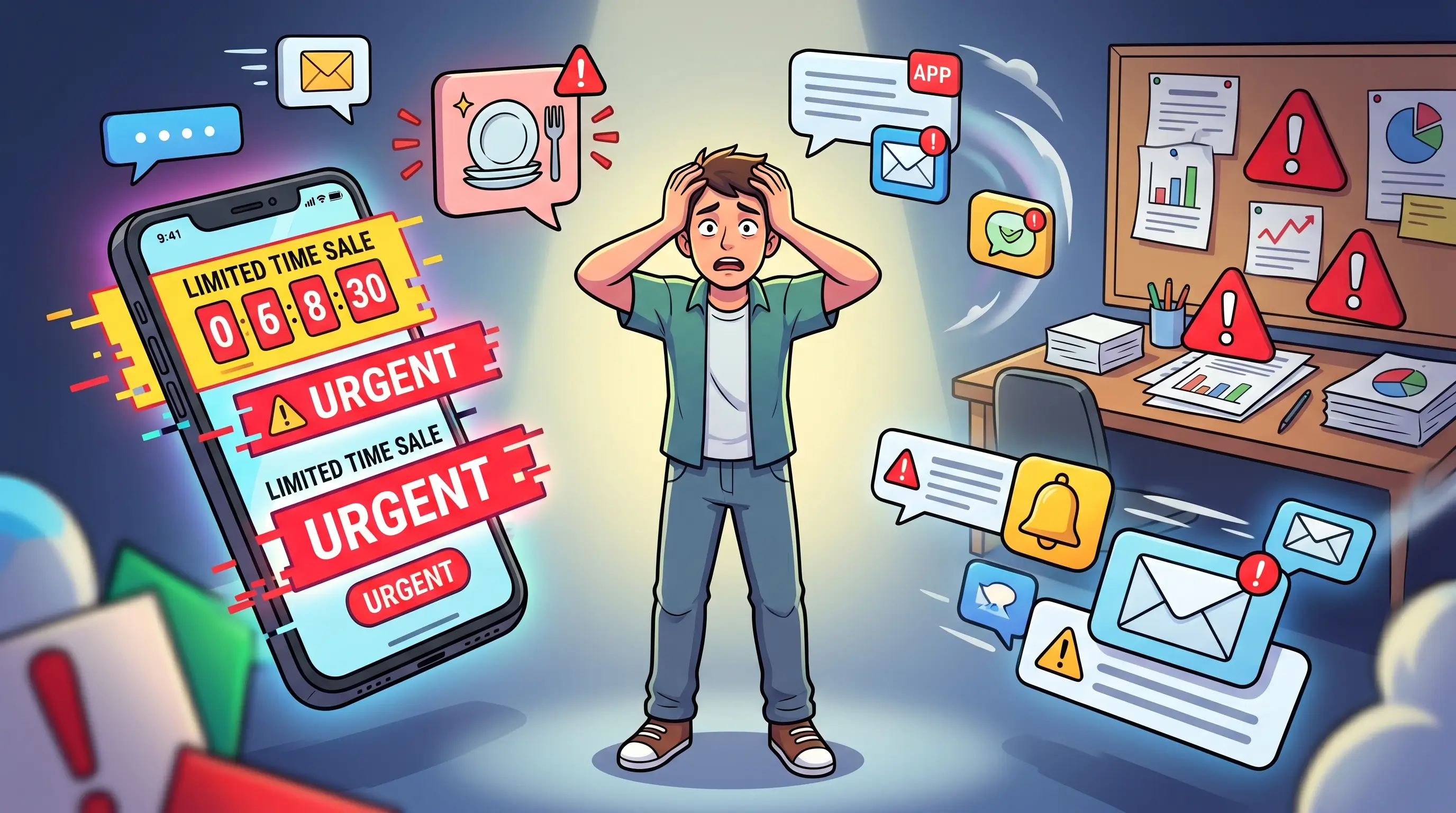
Modern life amplifies this effect. Digital platforms, workplace culture, and marketing systems all compete for attention. They do this by triggering urgency cues: countdown timers, notifications, deadlines, and emotional pressure. The brain slowly adapts to this environment and begins to interpret even neutral events as high priority.
The result is a lifestyle where people feel constantly behind, constantly reacting, and rarely in control of their time.
Example 1: The Never-Ending Limited Time Sale

One of the clearest examples of false urgency appears in digital marketing. You open a website and see messages like “Only 10 minutes left,” “Last chance,” or “Limited time offer.” These messages are designed to create immediate pressure.
However, the pattern often repeats. The same offer appears again the next day, sometimes with a new countdown timer. The urgency is not real; it is artificially constructed to trigger quick emotional decisions.
This works because human beings are loss-averse. The fear of missing out feels stronger than the satisfaction of gaining something. So instead of evaluating whether a product is needed, people react to the feeling of scarcity.
Over time, this trains users to associate shopping decisions with urgency rather than intention. Even non-important purchases begin to feel time-sensitive, which is exactly the psychological loop these systems rely on.
Example 2: Household Micro-Emergencies

False urgency is not limited to digital environments. It often appears in personal relationships and home life.
A simple situation, like an unwashed dish or a small delay in responding to a message, can sometimes be framed as an urgent emotional issue. Instead of being treated as a minor inconvenience, it becomes a moment of tension that demands immediate correction.
For example, a partner might react strongly to something small, not because the issue itself is significant, but because the emotional interpretation turns it into a “now” problem. The situation becomes less about the dish or delay and more about perceived respect, attention, or control.
This creates a pattern where small issues escalate unnecessarily. Instead of being resolved calmly, they trigger stress responses. Over time, this can increase emotional exhaustion in relationships, because the baseline level of urgency keeps rising.
The key issue here is not the situation itself, but the interpretation of importance.
Example 3: Workplace Friday Panic

Another common environment for false urgency is the workplace.
Many people experience what can be described as “end-of-week urgency.” A task or report that was not considered important during the week suddenly becomes critical on Friday. Deadlines appear tighter, communication becomes more intense, and teams rush to complete work that was previously low priority.
This type of urgency is often not based on actual importance but on delayed decision-making or poor planning. The work itself has not changed, but the perceived urgency has increased.
The result is a chaotic burst of activity that often produces stress rather than quality. Employees may work longer hours, make rushed decisions, or shift focus away from more meaningful tasks just to meet artificially compressed deadlines.
In many cases, this does not improve outcomes. Instead, it reinforces the belief that everything must be done immediately, even when earlier planning could have avoided the rush entirely.
This is one of the most damaging effects of false urgency in professional environments: it creates activity without direction.
Example 4: Digital Notification Overload

Perhaps the most widespread source of false urgency today is digital communication.
Phones, emails, messaging apps, and social platforms constantly send signals that demand attention. Each notification feels small on its own, but together they create a continuous background pressure.
The brain begins to interpret every alert as something important. Even when the message is trivial, the interruption itself trains the mind to stay in a reactive state.
Over time, this reduces deep focus. Instead of working on one task for an extended period, attention gets repeatedly pulled in different directions. This fragmentation creates the feeling of being busy all the time, even when meaningful progress is limited.
People often describe this as feeling “always behind” or “never caught up,” even when their workload has not objectively increased. That feeling is a direct outcome of constant urgency signals without real prioritization.
The Psychological Impact of False Urgency
False urgency is harmful not because it creates action, but because it creates unnecessary reactive action.
When the brain is constantly responding to perceived urgency, it has less capacity for planning, reflection, and prioritization. This leads to mental fatigue and decision exhaustion.
It also distorts time perception. Tasks feel more urgent than they are, which causes people to overestimate what needs immediate attention and underestimate what can wait.
Over time, this can lead to burnout. Not because of workload alone, but because of the emotional pressure of always reacting instead of choosing.
Another major effect is reduced productivity. When everything feels urgent, prioritization disappears. People start treating all tasks as equal emergencies, which makes it harder to focus on what actually matters.
How to Recognize False Urgency
The first step in reducing false urgency is awareness. Not every signal that feels urgent is actually important.
A simple mental filter can help: ask whether the situation will matter in a week or a month. If the answer is no, then the urgency is likely artificial.
Another useful distinction is between importance and urgency. Important tasks contribute to long-term outcomes. Urgent tasks demand immediate attention. False urgency often disguises itself as importance, even when it has no long-term impact.
Recognizing this difference helps shift the mind from reaction to evaluation.
How to Reduce False Urgency
Reducing false urgency does not mean ignoring responsibilities. It means slowing down the automatic reaction to pressure signals.
One approach is to introduce a short pause before responding to anything that feels urgent. Even a few seconds of delay can help the brain switch from emotional reaction to rational assessment.
Another method is prioritization. When tasks are clearly ranked by importance, it becomes easier to see which ones are truly time-sensitive and which are not.
Finally, reducing exposure to constant notifications can significantly improve focus. Less interruption means fewer false signals of urgency.
FAQs
What is false urgency?
False urgency is the feeling that something is urgent when it is not actually important or time sensitive.Why do people experience false urgency?
It is caused by repeated exposure to urgency cues such as notifications, marketing tactics, and workplace pressure.Is false urgency a mental health issue?
It is not a disorder, but it can contribute to stress, anxiety, and burnout if it becomes a persistent pattern.How does false urgency affect productivity?
It reduces productivity by shifting focus from meaningful tasks to reactive, low-value actions.Can false urgency be unlearned?
Yes, through awareness, prioritization, and reducing exposure to constant urgency triggers.Conclusion
False urgency is one of the most common psychological patterns in modern life. It makes normal situations feel like emergencies and keeps people in a constant state of reaction. By recognizing it, individuals can regain control over their attention, reduce unnecessary stress, and make more intentional decisions about where to focus their energy.


Comments (0)
No comments yet. Be the first to share your thoughts!
Leave a comment
Your comment will appear after it's reviewed. Your email is never shown publicly.